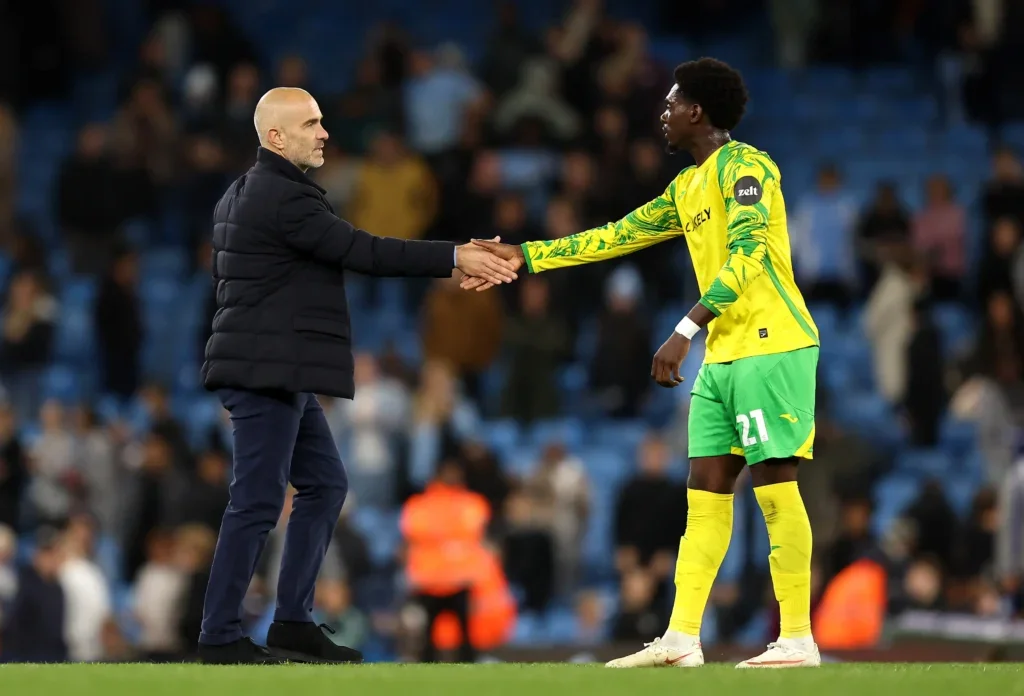
Mohamed Toure's late appearance showcased his talent, but Norwich's decision to bench him contributed to their 5-0 loss against Manchester City.
Missed Opportunities for Norwich
Norwich City’s League Cup match against Manchester City turned into a painful experience, particularly for star striker Mohamed Toure, who was left on the bench for the majority of the match. Manager Philippe Clement's strategy to manage Toure’s minutes ahead of a busy schedule backfired, as the Canaries faced an overwhelming 5-0 defeat. What should have been a chance to make a statement instead became a demonstration of tactical miscalculations.
The decision to bench Toure at a time when the team needed offensive firepower is puzzling. This isn't just about one game; it speaks volumes about the team's priorities and overall strategy. Norwich finds itself in a transitional phase, where results in cup competitions can sway momentum for or against a team. For a squad looking to rebuild and develop, every opportunity to field your best players should be taken seriously.
Late Arrival and Disallowed Goal
With only 20 minutes remaining and Norwich already trailing 4-0, Clement finally brought Toure onto the pitch. His late arrival did little to change the course of the match, but Toure’s sharpness quickly became evident. He netted a goal, showcasing his finishing ability, yet it was disallowed for being marginally offside. This missed goal wasn't just about the scoreline; it underscored what Norwich City had been missing during his time on the sidelines.
The decision to introduce him so late can be seen as a desperate attempt to rectify a dismal situation. By that point, the game was practically lost, and Toure's moment of brilliance only served to highlight the poor timing of the initial substitution. This could raise questions among fans and analysts: Why wait until the game was all but over? Was there a more effective way to manage player minutes while also giving the team a better shot at success?
Highlighting Young Talent

While Toure sat on the bench, Manchester City's 17-year-old Floyd Samba took center stage, scoring twice on his debut and assisting in another goal. This performance not only underlines Manchester City’s effective youth development but also emphasizes the missed opportunities for Norwich. The match showcased City’s depth, with new signing Allan Elias from Palmeiras also making an impression, marking his appearance with a debut goal. Young substitute Ryan McAidoo added the fifth goal just before the final whistle, making the contest one-sided.
For City, it’s a testament to their scouting and player development prowess, while for Norwich, it raises an uncomfortable question: Are they falling behind in this critical area? It's one thing to bring in young players; it's another entirely to integrate them effectively. If you're working in this space, you'll understand that developing homegrown talent is essential for long-term success.
Mismatch in Team Selection
Both teams fielded altered lineups, but Norwich's decision to make nine changes indicated a lack of priority for the cup fixture. Meanwhile, City, under Enzo Maresca, made ten alterations, resting star players like Erling Haaland. This mismatch in commitment to the cup may have been a significant factor in the outcome. The disparity is stark: one team seemed to view the match as an obstacle, while the other saw it as an opportunity.
When clubs decide to rotate players, the reasoning often hinges on balancing domestic league campaigns with cup competitions. However, Norwich's heavy rotation seems to reflect a deeper issue—a lack of belief in their squad's ability to compete at the highest level. And yet, if players like Toure aren't given the chance to impact matches early on, how can they ever gain the confidence needed to turn performances around?
Samba's Dominance
Samba's performance was pivotal, with his first goal coming from a far-post header after expertly receiving a cross from Nico O’Reilly. His second contribution involved assisting Rayan Cherki, enabling City to dominate the match scoreline. After the break, Norwich’s defensive issues worsened, allowing City to take full control. One player—one young player—managed to turn the tide in favor of City, while Norwich looked lost trying to manage their own game plan.
It’s fascinating to see how one debutant can make such a difference. In contrast, Norwich seemed disorganized, struggling to cope with the youthful exuberance and creativity that Samba brought to the game. The contrast in execution, both from the youth and experience on each team, illustrates broader systemic issues within the respective clubs.
— beIN SPORTS (@beINSPORTS_AUS) September 17, 2026
@Socceroos star Mo Toure gave @ManCity a taste of his lethal finishing ability, alas he was a touch offside as his @NorwichCityFC suffered a 5-0 @Carabao_Cup loss | Short + extended H/L coming up at beIN SPORTS CONNECT
https://t.co/mWko2vVvYo pic.twitter.com/2nX604YFQ3
Looking Ahead
This disheartening loss puts Norwich in a difficult position as they look to regroup. The team must assess their player management strategies to prevent similar outcomes in the future. The need for a clear vision and effective execution has never been more pressing. Meanwhile, Manchester City's victory gives them confidence as they prepare for their next round against Brighton, who recently eliminated Manchester United.
As Norwich heads back to the drawing board, they have the opportunity to reconsider their approach. This isn’t just about a single defeat; it’s a chance to reflect on larger issues at play, including team cohesion, strategy, and the importance of player fitness. Their future could hinge on how they react to this setback. What this means for you, the fans watching, is that there could be significant changes on the horizon for a team eager to return to form.

Discussion
Sign in to join the discussion.